China Made Open Source a Strategy. If It Pulls Back, Who Fills the Gap?
📚 Related: China May Restrict Its AI Exports — Your Local Models Don’t Care · Is Qwen Going Closed? Open Weights vs Frontier (2026) · Qwen 3.7 Open Weights Watch
A few days ago I wrote the calm version of the China export-control story: the weights already on your disk can’t be recalled, so the panic about local AI “dying” was aimed at the wrong target. That piece was for the person worried about the models they already run.
This one is for the other worry, the one that’s actually reasonable. If China does eventually wall off its next frontier open release (a future Qwen 4, a GLM-6), then the tap that’s been feeding the open ecosystem for two years slows to a drip. Qwen, DeepSeek and GLM have been the backbone of local AI. Pretend that supply gets restricted at the frontier and the honest question isn’t “are my current models safe” (they are). It’s “where does the next great open model come from?”
The doom take says nowhere. I think that’s wrong, but not for a comforting reason. A supply vacuum doesn’t stay empty; it gets filled. The only real question is by whom, and whether the West is set up to be the answer. Right now it half is, and the half that’s missing is entirely self-inflicted.
The uncomfortable truth: China won open source on purpose
Let’s start with the part that stings if you’re rooting for the home team. China didn’t accidentally end up owning the open tier. It chose to.
While OpenAI and Anthropic took the frontier closed and never looked back, Chinese labs did the opposite on purpose. Alibaba shipped Qwen under Apache 2.0. DeepSeek put R1 under MIT. Zhipu open-weighted GLM-5.2 and parked it at the top of the open leaderboard. These weren’t charity. Open weights are soft power: every developer on earth who builds on your model is one who isn’t building on an American one, and every GGUF mirrored to a thousand machines is a beachhead you didn’t have to pay for. China treated open source as national strategy and executed it better than anyone.
Meanwhile the West’s open commitment wobbled at the worst possible time. Meta, the company that made “open” respectable in this space with Llama, reportedly held back its Behemoth model in May 2025 over disappointing internal performance, and by July the New York Times was reporting that leaders inside Meta’s new Superintelligence Labs had discussed abandoning open source for a closed model entirely. Nothing’s been decided there either. But “the West’s biggest open-weights champion is openly debating whether to stop” is not the position of strength people assume it is.
So here’s the setup nobody likes to say plainly: the open lane was there for the taking, and the West mostly ceded it. China ran into the gap. That’s not a story about who has better researchers. It’s a story about who decided open weights were worth pouring national resources into, and who let them become an afterthought.
Who actually fills the gap: the honest roster
If the Chinese frontier tap slows, this is who’s standing there. I’m going to be straight about what each one actually is, because the boosters will oversell this and the doomers will pretend it’s nothing.
| Player | What they ship | How open | The catch |
|---|---|---|---|
| Ai2 (Allen Institute) | OLMo 3, 7B & 32B | Fully open — data, code, weights, checkpoints | Nonprofit budget vs Big Tech compute; competitive at 32B, not a frontier lead |
| Mistral (Paris) | Mistral 3 family, Large 3 | Dual: open (Apache 2.0) + proprietary API | The best models trend toward the paid tier |
| Apertus (Swiss AI / ETH) | 8B & 70B, 1,000+ languages | Fully open, incl. training data | Research-grade, not a daily-driver frontier model |
| EleutherAI | Pythia, Common Pile dataset | Fully open, copyright-clean data | Interpretability/research focus, small models |
| LLM360 / K2 | K2-V2, 70B | “360-open” — full flow | Tiny team, niche awareness |
| Independents | SmolLM3, Nous Hermes, and the long tail | Open weights to fully open | Scattered; no coordinated funding |
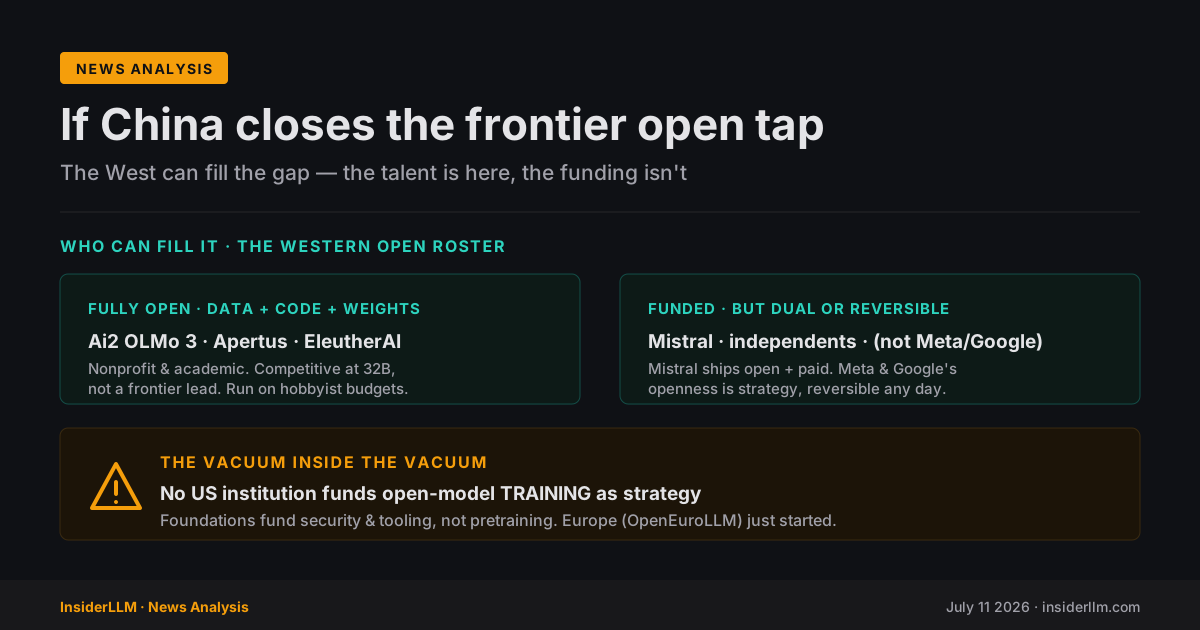
Start with the one that matters most for the principle of the thing. The Allen Institute for AI (Ai2) is the only major Western lab shipping a genuinely fully open model — not just weights, but the Dolma training data, the code, the checkpoints, even a tool that traces an output back to the data that produced it. OLMo 3 landed in November 2025 in 7B and 32B, and Ai2’s own benchmarks put the 32B “Think” variant competitive with Qwen 3 at the same size. Read that carefully: competitive with Qwen, not ahead of it, and only at 32B. Ai2 is a 501(c)(3) founded by the late Paul Allen, running on an endowment and estate funding reportedly north of $100M a year. That sounds like a lot until you remember it’s a rounding error next to what Alibaba or Meta throw at a single training run. The most principled open lab in the West is doing frontier-adjacent work on a nonprofit’s budget.
Mistral is the closest thing Europe has to a name-brand answer, and it’s a more complicated case. Its whole pitch is “open, frontier AI for all,” and it does ship real open-weight models — the Mistral 3 family under Apache 2.0, including a genuinely large Large 3. But Mistral runs a dual model: open tiers plus a proprietary API that pays the bills. It raised a €1.7 billion round in September 2025 led by chipmaking-equipment giant ASML, at roughly a €12 billion valuation, and was reportedly in talks for another €3B in June 2026. So it’s well-funded by open-source standards, but its incentives pull the best work toward the paid side over time. Bet on Mistral to keep publishing good open models, not necessarily its best ones.
Then the grassroots layer, which the doom take ignores completely. Switzerland’s Apertus shipped an 8B and 70B trained on 15 trillion tokens across a thousand languages, fully open down to the data, out of EPFL and ETH Zurich. EleutherAI, the nonprofit behind Pythia and The Pile, released Common Pile last year — a copyright-clean training corpus, which is exactly the kind of unglamorous foundation work that makes the whole ecosystem legally safer. LLM360’s K2 pushes “360-open” full-flow releases at 70B. Hugging Face keeps shipping fully-open small models like SmolLM3.
I’ll put my own cards on the table here, because it’s relevant. I contribute to this world myself — I run a small open-source project of my own (openbox). It is not going to fill anyone’s frontier gap, and I’m not pretending it will. But that’s the point about the grassroots layer: it’s a lot of small efforts, most of which you’ve never heard of, doing real work with no coordination and almost no money. “The West takes up the challenge” isn’t an abstraction I’m narrating from the bleachers. It’s a thing a lot of us are already doing, badly funded, in parallel.
Who is NOT the reliable savior
Here’s where I’ll disagree with the reflexive answer, which is “Meta and Google will just fill it.”
Maybe. But you’d be betting your open-source future on two companies whose openness is strategic and reversible. Meta’s Llama 4 Scout and Maverick are still open, and they’re genuinely useful. But as covered above, Meta’s leadership has openly discussed going closed, and Behemoth got held back. The open commitment is a mood, not a contract.
Google’s Gemma is real and good — Gemma 4 shipped in April 2026 under Apache 2.0, with hundreds of millions of downloads. But Gemma is an ecosystem play, a way to keep developers in Google’s orbit while Gemini stays firmly closed. It is goodwill, extended because it currently serves Google’s interests, and goodwill gets withdrawn the day the math changes. Building your open-source resilience on Gemma is building it on a decision Google can reverse in a single blog post.
The pattern with both: their open models are the trailing tier of a company whose real product is closed. That’s fine as a bonus. It’s dangerous as a foundation.
The vacuum inside the vacuum: nobody funds the training
Now the sharp point, and it’s the one that changed my mind while reporting this out.
You’d think the institutions built to steward open source would be on this. The Linux Foundation, LF AI & Data, OpenSSF — this is supposedly their job. And they are funding open-source AI. In March 2026 the Linux Foundation announced a $12.5 million grant, funded by Anthropic, AWS, GitHub, Google, Microsoft and OpenAI, to help open-source maintainers triage the flood of AI-generated security bug reports drowning their projects. Good and necessary work. There’s even a dark comedy to it: the AI companies chipping in to clean up the “AI slop” their own tools fire-hose at volunteer maintainers.
But look at what that money is for. Security. Tooling. Triage. Governance. LF AI & Data hosts and governs open-source AI projects — it’s a neutral home for software, not a body that pays to pretrain a model from scratch. Every dollar of Western institutional open-source funding I could find goes to the plumbing around models. Almost none of it goes to training the models themselves.
That’s the vacuum inside the vacuum. The expensive, strategic part, the actual pretraining compute that produces a competitive open model, has no systematic Western patron. Ai2 does it on an endowment. Mistral does it on venture money with strings attached. The independents do it on fumes. Nobody in the US has stood up and said “funding open frontier models is a national interest, here’s a program.” (And no, before anyone asks: Red Hat isn’t it. It’s an IBM-owned commercial Linux vendor, not a model-training foundation. The instinct to look for a “Red Hat of open models” is right; the org doesn’t exist yet.)
There’s exactly one exception, and it’s telling that it’s not American. Europe is actually doing the thing. OpenEuroLLM is a €37.4M publicly-backed program to pretrain open models (code, weights, and data) across dozens of European languages on EuroHPC supercomputers. Germany’s OpenGPT-X funded the Teuken-7B models the same way. Apertus came out of Swiss public research. When you line those up next to a US landscape where the flagship program (the NAIRR pilot) hands out compute access rather than funding open pretraining as strategy, the contrast is stark. The one Western bloc treating open-model training as public infrastructure is the EU, and it’s early days there.
The argument, plainly
Put it together and the shape is uncomfortable. The West currently free-rides on Chinese open weights. Most of the local AI stack people run, including plenty of mine, is Chinese-trained models that some other country decided were worth funding as strategy. Our own open capacity is real but scattered: a nonprofit here, a venture-backed lab there, a pile of underfunded independents, and one serious public program on the far side of the Atlantic.
That’s a fragile place to be, and it’s fragile by choice. If China restricts its frontier open releases, the West doesn’t lack the talent to respond. Ai2, Mistral, the Apertus and EleutherAI crowd, the independents — the capability is here. What’s missing is anyone treating it as important enough to fund like it matters. China made open weights a pillar. Europe started to. The US let it become a side project and then acted surprised that the best open models come from Hangzhou.
The fix isn’t waiting for Meta or Google to feel generous. It’s deliberately funding the mission-driven open labs and the independents, the Ai2s and the grassroots, the way China (and now Europe) fund open source: as strategy, not as charity. The vacuum will get filled either way. The only question is whether it’s filled by players the West chose to back, or by whoever’s left standing when the money finally shows up.
The honest caveats
I’d be doing exactly the thing this site exists to avoid if I left it as a clean rallying cry. So, the parts that complicate it.
This is a frontier-tier scenario, not a small-model one. The tiered framework floating around China’s discussions, traced to a Supreme People’s Court journal roundtable, puts basic open-source tools in the lightest bucket: a simple filing, not a ban. Small and mid-size models are the least likely to be restricted on either side. So this whole scenario is about the frontier open tier, the next Qwen-4-scale release. Your 7B and 27B daily drivers were never the thing at risk.
Chinese models dominate because they’re good, not just because they’re there. Filling the gap isn’t about publishing something — it’s about matching quality-per-parameter. OLMo being competitive with Qwen 3 at 32B is a genuine achievement precisely because it’s hard. The West doesn’t get to fill the vacuum by shipping mediocre open models and calling it sovereignty. It has to actually be as good, which is the expensive part nobody’s funding.
“The West stays open” isn’t clean either. The US fences its own frontier too. The same month all this China news broke, Commerce pulled Anthropic’s Mythos and Fable models for foreign nationals. Both superpowers gate the frontier; what survives on both sides is the open small-to-mid tier. This isn’t good guys versus bad guys. It’s two governments treating their best models as controlled tech, and an open ecosystem that persists underneath them because nobody’s figured out how to un-publish a weight.
None of that breaks the argument. It sharpens it. The opportunity everyone panicking is missing is that the vacuum is fillable and the talent is already here. The thing standing in the way isn’t China. It’s the West’s own refusal to fund the mission it claims to care about.
Reporting drawn from Ai2, Mistral, the Linux Foundation, OpenEuroLLM, and ETH Zurich. Meta’s open-weights uncertainty per Axios and TechCrunch. Companion piece: China May Restrict Its AI Exports — Your Local Models Don’t Care.
A weekly email with every new guide and measured benchmark.
Subscribe — free, no spam