China May Restrict Its AI Exports — Your Local Models Don't Care
📚 Related: If China Pulls Back, Who Fills the Gap? · Is Qwen Going Closed? Open Weights vs Frontier (2026) · Qwen 3.7 Open Weights Watch · How to Run GLM 5.2 Locally
On July 7, Reuters reported that China’s Ministry of Commerce had spent the past month meeting with Alibaba, ByteDance, and Z.ai (Zhipu) to discuss restricting overseas access to the country’s most advanced AI models. Three weeks earlier, the US Commerce Department did something structurally identical to Anthropic. Both stories broke to a chorus of the same headline: some flavor of “[country] BANS OPEN AI.”
Neither headline is right. The real story is more useful than the scary one, and it hands you something to act on. For the first time, geopolitics is a concrete reason to keep models on your own disk instead of on someone else’s servers.
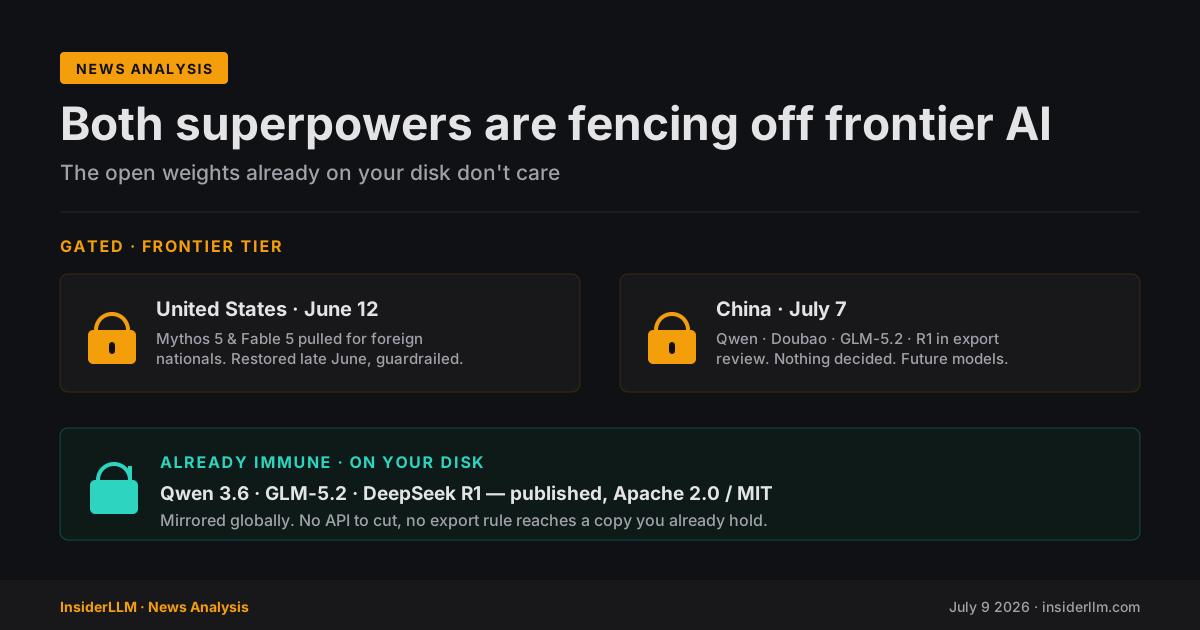
What China actually discussed
Per Reuters’ reporting (carried on Yahoo Finance), the Ministry of Commerce, with the National Development and Reform Commission also in the room, convened Alibaba, ByteDance, and Z.ai to talk through limiting foreign access to their top models. The models named were Alibaba’s Qwen, ByteDance’s Doubao, Z.ai’s GLM-5.2, and DeepSeek’s R1.
The framework on the table, traced to a May roundtable summary in an official Supreme People’s Court journal, is tiered:
- Basic open-source tools: a simple filing.
- More capable models: a security review.
- The most sensitive frontier models: barred from public release, or restricted to domestic use only.
Officials also floated making the leak or theft of proprietary AI technology a national-security offense, and putting limits on who can fund domestic AI startups.
The aggregators dropped the one line that matters: nothing has been decided. Reuters’ own sources said the curbs “may only apply to future models,” and that “it was not immediately clear when or even if they would come into force.” The internet did what it does. Within hours r/singularity had the story past 600 upvotes, then bolted on an edit calling it “debunked.” r/LocalLLaMA got skeptical too.
Both reactions miss in the same direction. No decree got signed, so the panic is early. But calling it debunked is just as wrong. This is Reuters, on the record, reporting real meetings with named companies, and Quartz, The Next Web, and TIME all carried it. “We discussed it, nothing’s final” isn’t a non-story. It’s the stage where paying attention is cheap and reacting late is expensive.
This is a tit-for-tat story, not a China story
If you frame this as “China cracks down,” you miss the actual news: both superpowers are now treating frontier models the way they treat fabs and controlled tech.
Rewind to June. On the 12th, the US Commerce Department ordered Anthropic to cut off foreign-national access to its two frontier models, Mythos 5 and Fable 5. The stated reason was a reported exploit that could jailbreak the models into identifying cybersecurity vulnerabilities in critical infrastructure. The catch: Anthropic couldn’t do real-time nationality checks on its users, so to comply it pulled both models for everyone, reportedly including the NSA.
It took most of a month to unwind. Secretary Lutnick issued a follow-up letter on June 26 exempting “certain trusted partners” and their foreign-national staff. Around June 30, the controls lifted: Fable 5 came back globally with tighter guardrails, and Mythos 5 was restored first for approved US organizations. The Peterson Institute called the whole thing “the Fable of the Mythos saga.”
China noticed. The day after Commerce pulled Fable, Zhipu shipped its open GLM-5.2 — the #1 open-weights model on the leaderboard, MIT-licensed, already mirrored everywhere — and founder Jie Tang opened the launch post with a line aimed straight across the Pacific: “the sudden restriction of certain frontier models is deeply regrettable.” A US frontier model goes dark on a Friday; a Chinese open-weight rival ships on Saturday with a statement attached. That’s the whole dynamic compressed into one weekend.
Line the two up and the shape is the same. A government looks at its most capable domestic models, decides they’re strategically sensitive, and reaches for export-control machinery built for a different era. The open-frontier period, when the best models were a login or a download away from anyone on earth, is getting fenced in from both ends at once.
What’s actually at risk versus already immune
This is where the accurate version pulls away from the slop, because the slop implies your current downloads are in danger. They’re not, and the reason is simple: you cannot un-publish a weight.
Three of the four models named in China’s talks are already out in the open under permissive licenses. Qwen 3.6 (the 27B dense and 35B-A3B) is on Hugging Face under Apache 2.0. DeepSeek R1 has carried an MIT license since early 2025. GLM-5.2 launched June 13, and its MIT-licensed open weights landed three days later, on June 16. Every one of those has been mirrored, torrented, and pulled into GGUF and MLX conversions thousands of times over. No commerce ministry on either continent has a mechanism to reach copies that are already on people’s drives.
So the restriction talk is, necessarily, about what comes next.
| Bucket | Examples | Why it lands there |
|---|---|---|
| Already immune (published, mirrored) | Qwen 3.6-27B / 35B-A3B, GLM-5.2, DeepSeek R1, Qwen 2.5 family, most small and mid models | Open weights can’t be recalled; copies are already global |
| Genuinely exposed | The next frontier open tier: a future Qwen 4 open release, a GLM-6, or the next DeepSeek generation | A tiered scheme keeps frontier home and lets the public tier trail a step behind |
| Never in scope | Small, basic open-source tools | Explicitly the lightest tier (a simple filing) in the proposal |
There’s a quiet irony in the middle column. Qwen’s 3.7 open weights were already overdue and uncertain before any of this. Alibaba shipped 3.7-Max, Plus, and VLA as paid API-only endpoints, and as of today there’s still no 3.7 open repo on Hugging Face (I track that on the open-weights watch). “Frontier stays home, public tier trails a step” isn’t a hypothetical policy outcome. It’s a fair description of what Alibaba is already doing for commercial reasons. A tiered export rule would just formalize a gap that’s already there.
The real payload: local as supply-chain insurance
Follow that one step further. If a government letter can gate or freeze a frontier model overnight, on either side of the Pacific, then the case for running local stops being only about privacy and cost. There’s a third thing on the list now, and it’s the one nobody was pricing in: no policy reaches your hard drive.
The Fable episode already ran the experiment for us. A model thousands of businesses had built on went dark for all of them, US government users included, because a compliance rule turned out to be impossible to implement cleanly. Not a thought experiment. Three weeks of June. If your stack ran on a hosted endpoint that month, it was really running on a policy holding steady, and the policy didn’t hold.
You don’t have to take my word for the mechanism. The Peterson Institute economist covering the US controls made the same point without any local-AI axe to grind: ad hoc model controls “boost international adoption of Chinese AI models,” because Chinese labs ship open weights that users download locally, and “once downloaded, providers cannot restrict access — a feature that just became a greater selling point.” Export controls on hosted models are an advertisement for weights you can hold.
A model on your disk gives a policy nothing to grab. No API to shut off, no nationality check at the door. And no letter from Commerce reaches a file that’s already sitting on your SSD. None of that is a claim about capability. Local still trails there, and I’ll get to it. It’s a claim about supply, and supply is the lever both governments just reached for.
What I actually did about it
I archived my Qwen weights this week. Not because I think Alibaba’s servers are going dark tomorrow. I don’t. I pulled clean copies of the Qwen 3.6-27B and 35B-A3B GGUFs I actually run, checksummed them, and dropped them on a second drive alongside the DeepSeek and GLM weights I keep around.
I want to be honest about what that is, because the content farms are going to turn this into “DOWNLOAD NOW BEFORE IT’S GONE,” and that’s not the move. My current weights aren’t going anywhere: they’re Apache and MIT, they’re mirrored everywhere, nobody can claw them back. Archiving them isn’t panic-buying, it’s the whole point of running local finally paying rent. The reason local AI is worth the hassle is that my stack doesn’t depend on anyone’s policy staying put. Spending twenty minutes to make that literally true (a cold copy that survives any repo takedown or license change) is cheap insurance, not a fire drill.
If you run local and you’ve never actually archived the weights you depend on, this is a reasonable week to do it. Pull the GGUFs or safetensors you use, verify the hashes against the model card, and stash a copy somewhere that doesn’t depend on Hugging Face staying up or a license staying open. That’s it. No urgency, just hygiene that the news finally made concrete.
The honest caveat: you’re trading capability for control
Now the part the “local wins” crowd skips. Local models lag the frontier, and this news doesn’t change that.
These models are immune to export controls precisely because they’re a step behind. That’s the reason they got published as open weights at all. Qwen 3.6-27B on your 3090 is genuinely good, and it is still not Qwen 3.7-Max, Claude Opus 4.8, or GPT-5.6 Sol. For a genuinely hard reasoning chain, or a long agentic task where the model has to stay coherent for an hour, the hosted frontier is often worth the supply risk. That’s a real trade. Pretending it isn’t would be the exact marketing-flavored dishonesty this site exists to avoid.
None of this makes local the winner. It adds a variable to a tradeoff you were already running. The old calculation weighed capability against privacy against cost. The new one adds a fourth axis nobody had to think about until this summer: how badly do you need your workflow to survive a government letter you never saw coming?
For plenty of tasks the honest answer is still “pay for the frontier and eat the risk.” But some work you can’t afford to have vanish for a month. The pipeline behind a product. The assistant you’ve quietly wired into everything you touch. For that, the math now tilts toward the weights you own outright. Both superpowers just spent the summer proving why.
Reporting drawn from Reuters (via Yahoo Finance), Quartz, and the Peterson Institute for International Economics. Model licensing verified against the Qwen 3.6 and DeepSeek R1 Hugging Face model cards.
A weekly email with every new guide and measured benchmark.
Subscribe — free, no spam